How to play
A memory game for 2 to 4 players, by Jonathan Leistiko (invisible-city.com/content/16-memories). Everyone plays for themselves.
Every board starts the same way
- Sixteen different tiles from one set (letters, numbers, words, flags or shapes) are laid out on a 4 by 4 board.
- All 16 are face up for one minute. Look as hard as you like. Then they all turn face down.
- No notes. The rules do not allow them, so the game gives you nowhere to write (except option 3's note sheet).
Before the game, the table picks one of three ways to play the rest. They are three different games.
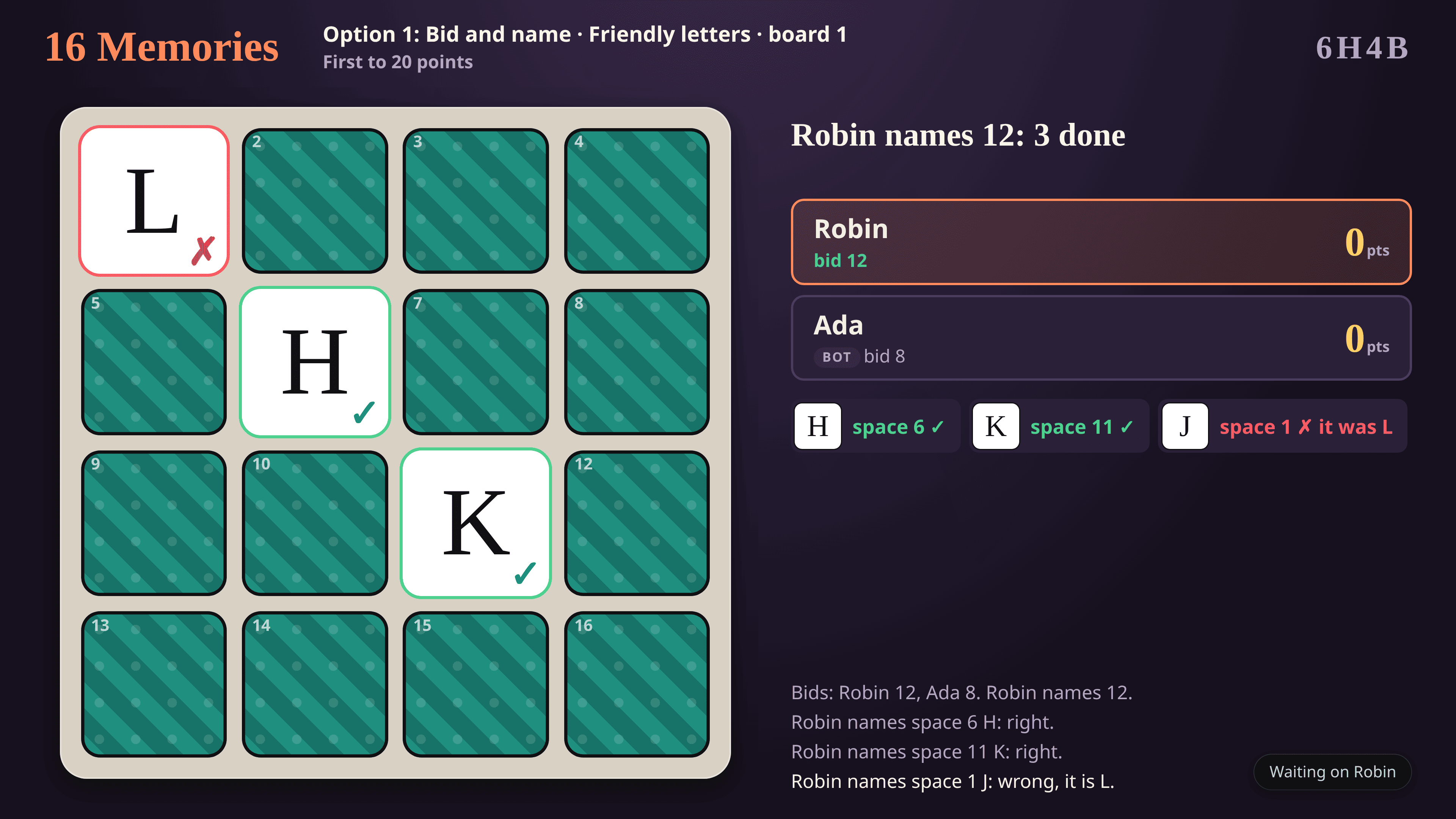
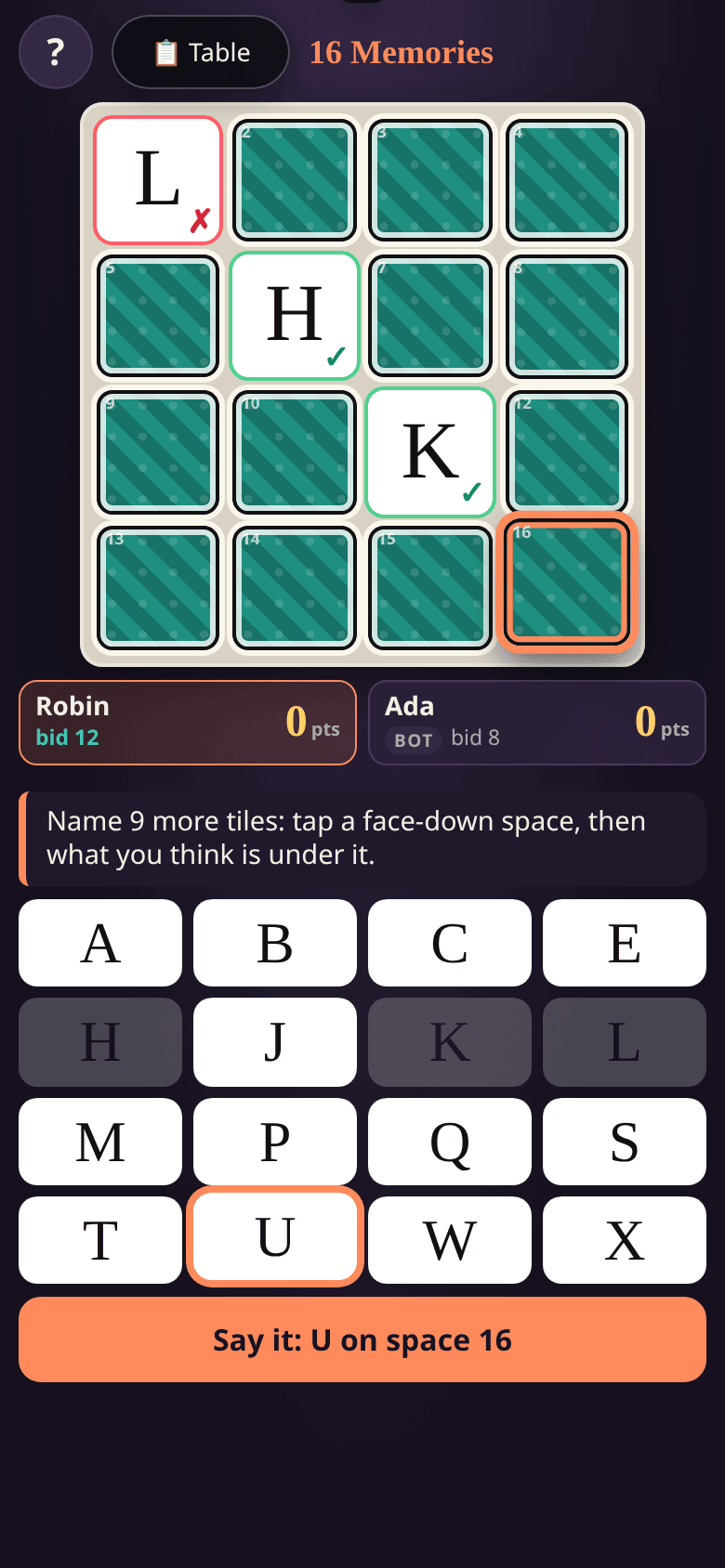
Option 1: bid, then name them
- Everyone bids, in secret, how many tiles they can name (1 to 16). The bids are shown when all are in.
- The highest bid plays. If two or more players tie for highest, the next-highest bid plays instead; if nobody's bid is alone, everyone bids again.
- The player taps a face-down space, says what is under it, and it turns over. As many times as the bid.
- All right: you add your bid to your score. Wrong even once: every other player adds one point for each miss.
- Then the tiles are shuffled into a new board, with a new minute to look. The first to 20 points wins.
Option 2: the pawn
- The pawn starts in the top-left corner. On your turn the die is rolled and the pawn moves that many spaces, reading order (left to right, top to bottom, then round again).
- Name the tile under the pawn, or pass. Right: the tile goes to your treasure pile and you go again. Wrong: everyone sees it, it turns back face down, and your turn ends.
- The board is never reshuffled, so a miss is a reminder for everyone. When the last tile is taken, the most tiles wins.
Option 3: the note sheet
- After the look, the tiles stay face down for another minute, and nobody may write.
- Then you get a minute to fill in your note sheet: tap a space, then a name. Nobody else sees your sheet until the minute is up.
- One point for each space you got right, two for one nobody else got right. New board, new round.
- You win with more than 16 points and at least 4 more than every other player.
Adults and kids
With the "4 shapes, 4 colours" set, a player can switch on the kids' rule for their own seat in the lobby: they only need the shape or the colour right. Everyone else needs both.
Good to know
- The timer is real: one minute, on every screen.
- Bots fill empty seats. They see what a player sees and remember about half of it, sometimes wrongly.
- If your phone sleeps, your seat waits. A bot covers for you only after five minutes, with a clock on screen first, and one tap takes the seat back.
- The rules were found, not remembered: Jonathan made the board and the tile sets in 2006 and wrote these three ways to play when he came across them again a year later. Which set is hardest is part of the fun.